Author: Purushottam

  • True Faith is the Key to Understanding the Infinite

    True Faith is the Key to Understanding the Infinite

    Goswāmī Mahārāj: This is the last opportunity for going to have to me(?) with you and any final questions think we ever(?) discussed. Any questions on anything we’ve discussed or anything that we’ve not discussed.

    Question: Could you say what is the difference between veritable faith and ostentatious faith. Does the veritable faith come to nothing more that limits of one religion and whether must it be supported by any rituals?

    Goswāmī Mahārāj: That’s a very good question. Because then we need to define first what is faith. And that’s giving us

    ‘śraddhā’-śabde—viśvāsa kahe sudṛḍha niśchaya
    kṛṣṇe bhakti kaile sarva-karma kṛta haya

    It means if I dedicate myself in belief in one thing that everything is achieved, nothing will be neglected. In that act I want I cannot be accused to be irresponsible. So there is one place where I can put all my energy, my focus, my belief active apparent exclusion of all other things but yet at the same time meet all requirements. The belief that this is possible that’s the beginning of culture of faith.

    In the same place what it is mentioned some examples were given to help us that’s the purpose of example or metaphor, analogy to help us properly conceive something. So it says that just like pouring water on the root of a tree through the trunk, the branches, the twigs, the leaves everything is nourished. When you pour the water on the root, objectively speaking, someone can say: “Oh, you are neglecting so many leaves. They need water. All these leaves, these buds, their fruit potential, you are neglecting them, putting all water on the root”.

    So sometimes people will accuse those exclusively dedicated the culture of faith as being socially negligent. That’s a misguidance, superficial for the vision. When you pour water on the root all the leaves are nursed, everything is taken care. So really that means redirecting one’s focus towards the absolute centre. But we’ll have to factor in what is our capacity for belief. It’s very small. And if we try to use reason or knowledge to enhance faith it may be cannot(?) productive. Because what we know is based upon our limited experience of the limited. That won’t be helpful in trying understand the unlimited or the infinite. Like we have Aesop’s fables in Greece there’s a (?) in India in Pancharatra. So it’s told once in a pond a little baby frog, his mother goes off for one frog business. And a giant elephant comes to drink from there. And for the little baby-frog this is totally beyond his experience. So he’s astonished to see a being of such mass and capacity. When the elephant leaves his mother returns.

    “Oh mummy, you can’t believe a being that I saw with size inconceivable”. And she inflates her belly: “Was it this big”? “No, no, no, huge”. She inflates the belly more: “Is it this big?” He says: “Not even close”. Then she inflates her belly to a point of “phoo”.

    So why this is given as an analysis, this is the mind, intellect trying to conceive the infinite. In Bhagavad-gita Krishna reveals to Arjun His virat-rupa, which is merely like a gigantic form, or we say, gigantic, universal in size and dimension and variegatedness. And Arjun endowed with the vision to be able to see that he is astonished. He sees inumerable forms, inumerable universes, all living beings, everything all time space creation. But Krishna says: “Let Me know when you have enough. Because whatever you conceive as infinite to me is atomic, it’s nothing, it’s insignificant.

    Sometimes we are told He is lying on Anantashesha, the bed of the unlimited, the personification of unlimited Anantadev. So, in other words, you have the infinite, the unlimited laying using the infinite as a bed. So what is our capacity? Still our prospect lying on a culture of faith is the infinite, the finite may not be able to know the infinite, but finite means that the infinite can make itself known to the finite by infinite means. And, fortunately for us, that transcends all relative disqualifications. Because, ultimately, this is about heart. The reason says: “No”, the heart says: “Yes”. So we are not talking about an impersonal infinite, but an infinite Supreme loving Lord of heart, heat capacity. And that the Gita is spoken during the famous battle of Kurukshetra. And before this war took place, there was some attempts of diplomatic negotiated solution.

    So one point Krishna Himself went to try effect diplomatic solution. And because Arjun had renowned all of military asset(?), he said: “I only want one thing: Krishna is my charioteer.” And on top of it all Krishna said: “I won’t fight, I won’t take up any arm, I’ll just be a charioteer”.

    As a footnote, to have the infinite Supreme Lord driving your chariot is a good choice.

  • Without Nitāi—there is no Gaura

    Without Nitāi—there is no Gaura

    We have to think—what are we representing? We hear that self deprecation and negative expression is the wealth of a Vaiṣṇava. So, we shouldn’t be afraid of expressing the depths of our own negativity. But at the same time we have to think of our Guru-varga, their wealth and their position. So, Śrīla Guru Mahārāj quoted Śrīla Kṛṣṇadās Kavirāj Goswāmī many times, saying:

    jagāi mādhāi haite muñi se pāpiṣṭha
    purīṣera kīṭa haite muñi se laghiṣṭha

    (Chaitanya-charitāmṛta, Ādi, līlā, 5.205)

    “I’m more sinful then Jagāi and Mādhāi, and I’m lower then a worm in the stool.” But at the same time he said, “But, what I’m writing in this Chaitanya-charitāmṛtam about Śrī Chaitanya Mahāprabhu—there is nothing higher than this. There is no-one one lower than me. Someone who is as fallen as myself can be an instrument, the weapon for expression of the highest thing by the mercy of the Lord and His devotees.”

    nityānanda bole kṛpa avatāra

    He says, “I’m ashamed to say this, I’m shy to tell it, but Nityānanda Prabhu came to me once in a dream, or in a vision. Because my relative, he didn’t properly appreciate the position of Nityānanda Prabhu and I chastised him for that. He thought it’s enough that he has some appreciation for Mahāprabhu, but for Nityānanda Prabhu, he thinks it’s unnecessary to have that same appreciation for Him.”

    But we hear: vidyā-kule ki koribe tāra, Narottam Ṭhākur saying: “If you don’t appreciate the position of Nityānanda Prabhu, then what is your learning, your high family connection is all useless.”

    heno nitāi bine bhāi, rādhā-kṛṣṇa pāite nāi,
    nitāiyer koruṇā habe, braje rādhā-kṛṣṇa pābe,

    Without the mercy of Nityānanda Prabhu there is no possibility of entering that higher plane of Vṛndavān. So, Kavirāj Goswāmī told his brother, he said: “Your philosophy is ardha-kukkuṭī-nyāya or half-hen philosophy.”

    Half-hen philosophy means, there is the side of the chicken that gives the egg and you are interested in that. But the mouth side, the side that you have to feed—you’re not interested because that costs something. The flaw in that is that where there is no feeding, there is no egg.

    You think, really, without the mercy of Nityānanda Prabhu, without Nitāi—there is no Gaura. And these feelings, these sentiments they were like a volcanic eruption when they came out of Kaviraj Goswāmī. And maybe he was a little surprised by what he spoke and that he spoke with such force.

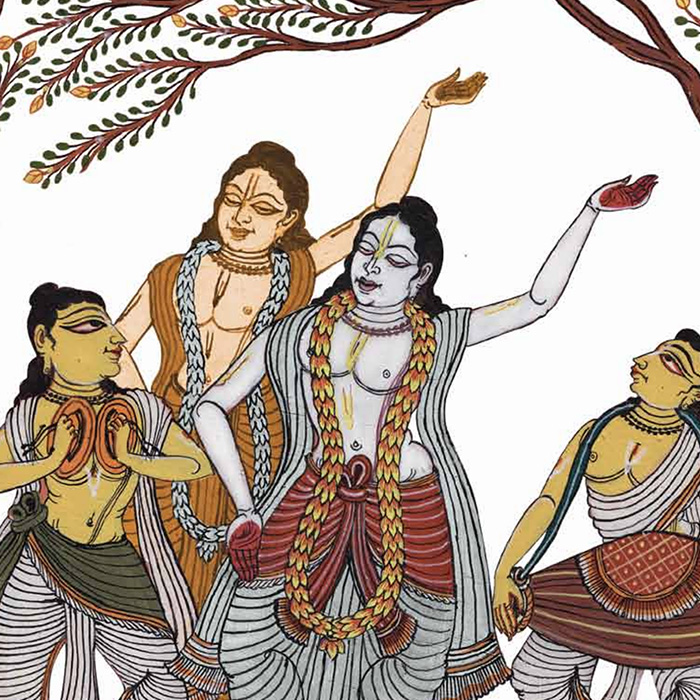
    But that night in a dream Nityānanda Prabhu appeared to him. And we are told that Nityānanda Prabhu was there in a very deep state of divine intoxication, swaying back and forth and dressed very beautifully. And He was chanting in a deep voice: “Kṛṣṇa, Kṛṣṇa…” and surrounded by His eternal servitors. He had a big flower garland, and many bees, who are also great sages, they are taking honey from the lotus feet of Nityānanda Prabhu. It’s a very intoxicated scene.

    And He said, “Kṛṣṇadās, you go to Vṛndavān.” And Kaviraj Goswāmī awoke very happy, saying, “Oh, I’ve been given entrance to Vṛndavān by Nityānanda Prabhu.” And He said, “Kṛṣṇadās, there you will get everything.”

    So, when Kṛṣṇadās Kavirāj Goswāmī went to Vṛndāvan, what happened? He got the association of Raghunāth dās Goswāmī. And from him he got everything. He got the whole Chaitanya-charitāmṛta, which is the greatest theological book. Guru Mahārāj says, “In all time and space and all of the creations.” That book all comes from the notes of Svarūp Dāmodar Goswāmī.

    So, Raghunāth dās got all the wealth, the svarūp bhāṇḍār, the treasury of Svarūp. The whole wealth of Mahāprabhu is deposited with Svarūp Dāmodar and he gave that to Raghunāth dās Goswāmī. And Raghunāth dās Goswāmī in turn delivered that, the whole wealth through Kṛṣṇadās Kaviraj Goswāmī. And Kaviraj Goswāmī with the blessings of the Vaiṣṇavas and the confirmation from Madan Mohan Vigrahā, began writing the Chaitanya-charitāmṛta.

    And he says, he is amazed at that time, because he is well into his nineties and he has arthritis and he can’t see, he is legally blind, but he is writing the greatest theistic book ever made. He is saying, “How is that possible? Some divine power is coming down and it’s moving my hand. Rādhā Madan Mohan, they are causing me to write all this things.”

    Rāmānanda Rāy says, “His position is the same, I’m like a bīṇā (string instrument). As you play me, that’s the sound that everyone hears. You are playing me like an instrument.”

    And in the very beginning of that Rāmānanda-saṁvad Kaviraj Goswāmī gives a beautiful śloka:

    sañchārya rāmābhidha-bhakta-meghe
    sva-bhakti-siddhānta-chayāmṛtāni

    Kaviraj Goswāmī says, “Who is Mahāprabhu—He is the bhakti-siddhānta-chayāmṛtāni, He is the nectarean ocean of bhakti-siddhānta, that is who Mahāprabhu is. Then who is Rāmānanda? Like a cloud. An ocean creates a cloud. So, from the nectarean ocean of bhakti-siddhānta the cloud bhakta-meghe the devotional cloud of Rāmānanda appeared above that ocean. Then what did he do? He showered unlimited nectar back on the ocean of bhakti-siddhānta, the nectarine ocean of bhakti-siddhānta. This is the real cloud. Now everyone is talking about cloud, this is the real cloud you want to know about. Bhakta-meghe, the devotees become nectar clouds. And they are showering nectar on anyone, who has the ears to catch that matter.

    But really that is the beauty of Kṛṣṇa Consciousness. That whatever appreciation we have for this is also a gift from Guru. It’s not that we have some independent capacity, they are gifting us the capacity to appreciate what it is that they are giving. That’s why we are hopeful. Because we are thinking, “Oh, I’ll never understand.” Yes, like that jagāi mādhāi haite… who am I to appreciate this?

    One time Guru Mahārāj said, “Mahāprabhu took sannyās, and then he goes to Purī. Firstly he is in his divine madness, chanting.”

    hāhā kṛṣṇa prāṇa-nātha vrajendra-nandana!
    kāhāṅ yāṅa kāhāṅ pāṅa, muralī-vadana!

    (Chaitanya-charitāmṛta, Antya-līlā, 12.5)

    He is chanting, “Where is Kṛṣṇa?!” He is running, searching for Kṛṣṇa in divine madness. Guru Mahārāj said it is like He is ‘in a child-like state.’ But then, after some time, he goes to Purī and sees Jagannāth. There, when he meets with Sārvabhauma Bhaṭṭāchārya, who is the greatest thinker of the day, Sārvabhauma in scholarly arrogance is thinking, “Oh, this boy, He is so charming, I think, if I teach Him, I can upgrade Him to a higher understanding.”

    And he is talking to Mahāprabhu every day for seven days about Vedanta and very excitedly presenting it and very comprehensively. But he notices that Mahāprabhu is not giving any indication that He is comprehending what is being said. So, he thinks, “Maybe it is a little too high for Him…” and says, “Please give some indication that You understand what I’m saying.”

    Mahāprabhu says, “I understand Vedanta, I just don’t understand what you are saying.”

    And Sārvabhauma is shocked, “What! This young boy is telling me Vāsudev Sārvabhauma Baṭṭācharya, the biggest scholar in India…”

    He doesn’t know that when Mahāprabhu was posing as a primary teacher in Nabadwīp that he defeated Keśava Kāśmīrī, greatest of scholars. When they were walking on the Gaṅga, Nimāi Paṇḍit, His young disciples and Keśava Kāśmīrī, they told that Keśava Kāśmīrī is the favorite son of the goddess Sarasvatī. So in great creative mood, he started off and he composed on the spot one hundred ślokas in praise of Mother Gaṅgā.

    Even he was surprised with his tongue, saying all this things. One hundred original complicated complex Sanskrit ślokas composed on the spot. So he’s thinking, “Do you know, I am…” And Mahāprabhu says, “And in this particular verse, I’d like you to explain that.” And then He quotes it.

    Then Keśava Kāśmīrī is thinking, “I don’t even know if I remember all of them, and He remembered it. Is that an error, a mistake?”

    And there, Mahāprabhu shows some fault in the presentation regarding Lord Śiva and his wife. Anyway, at that time, Keśava Kaśmīrī realized that Mahāprabhu is divinity. So, here again, when Mahāprabhu met with Sārvabhauma, the tables turn. Now Mahāprabhu upgrades Sārvabhauma Baṭṭācharya to His Kṛṣṇa conception, because it’s not about scholarship, it’s about mercy.

    athāpi te deva padāmbuja-dvaya-
    prasāda-leśānugṛhīta eva hi

    (Śrīmad-Bhāgavatam, 10.14.29)

    Prasād means mercy. Prasāda leśa means, if you get a little bit of prasād, a little bit of mercy, then the infinite can be revealed. So, Mahāprabhu was merciful to Sārvabhayma Bhaṭṭāchārya. And then in the end Sārvabhauma felt some remorse and some guilt thinking, “Oh, previously this Rāmānanda sometimes I was marking him: ‘Oh, he is a Vaiṣṇava. Now I can understand, what kind of Vaiṣṇava he is, the highest type of Vaiṣṇava and I couldn’t appreciate that before.’”

    So, he told Mahāprabhu as He was preparing for His tour of South India, “You should definitely visit Rāmānanda Rāy, when you’ll go to Godāvari.” And that’s where the Rāmānanda-saṁvād took place. So, then after the tour of South India and everyone He met, whatever their religious connection was, He demonstrated the superiority of Kṛṣṇa Conception.

    After so much time He again came back to Purī and again met with Sārvabhauma Bhaṭṭāchārya again. And at that time Mahāprabhu said to Sārvabhauma, “You know, I just toured the whole of South India, which is famous for religiously advanced people. And I didn’t find a single man like you.”

    But Guru Mahārāj said that “Mahāprabhu is indirectly praising Himself.” When He said “I didn’t find a man like you”, yes, after Mahāprabhu created him and turned him into something, upgraded him to His conception, then He says, “No-one that I met, was equal to what you’ve become.” And therefore we say, Mahāprabhu extended the capacity to him by His divine mercy to appreciate this superior substance. Prasāda-leśānugṛhīta eva hi—it’s all about mercy.

    jogyatā-vichāre, kichu nāhi pāi,
             tomāra koruṇā-sāra

    (Śrīla Bhaktivinod Ṭhākur. Gurudeva, 4)

    “If you examine me, you will find no qualities. Your mercy is everything to me.”
  • “Art is a Lie that Tells the Truth” (Picasso)

    “Art is a Lie that Tells the Truth” (Picasso)

    “All art is quite useless,” quipped Oscar Wilde; still it may be unbelievably expensive.

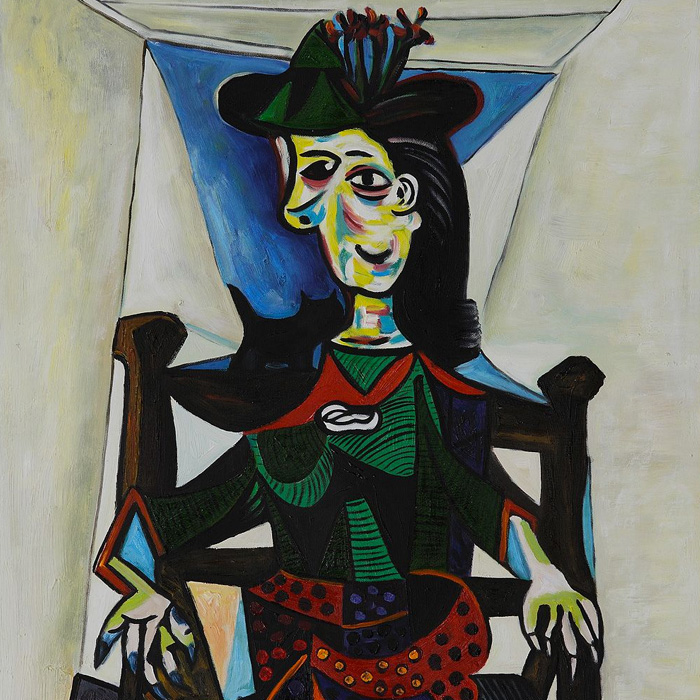
    A Picasso portrait, “Dora Maar With Cat,” sold for $95.2 million at Sotheby’s recently, the second-highest price ever paid for a painting at auction.

    The image of Maar, one of Picasso’s mistresses, was sold on the second night of the important spring auctions. “Boy With a Pipe” (1905) holds the record price for a Picasso. That painting sold for $104.2 million in May 2004.

    How does something that has no real monetary value (oil paint, canvas etc.) achieve the economic equivalent of enriched uranium; at what stage does a work of art go nuclear? When the subjective rises up and totally eclipses the objective.

    Aging, deteriorating Picassos; their subjective worth, wildly increasing in the world of perception, unleashed inordinate objective value. The recent auction caused a buyer’s frenzy, as avatars of bidders, descended from around the world, betraying beauty’s power to possess and play one like a doll.

    Affluent cognoscenti, connoisseurs of consciousness, pride themselves on being autonomous free agents moving within the plane of exploitation with immunity. Guided by good taste, poised to procure the priceless, inevitably they become slaves of art—at last only to be possessed by the higher power of descended beauty.

    B. R. Sridhar Dev-Goswami observes in Reality the Beautiful: “Generally, whenever we see beauty, we think that beauty is to be exploited, but beauty is the exploiter, beauty is the master, and beauty is the ultimate controlling principle.”

    How to convert matter into something valuable is not merely a capitalist’s trick; it requires consciousness to move over it. Without consciousness matter has got no value. Gold is of no value amongst the jackals and tigers. Matter is valued according to the demand of the subjective world.

    Converting the abstract into the tangible—the subjective into the objective—means someone’s subjective realization is expressed objectively as art. As we come nearer to spirit proper concept is substance.

    Ayn Rand Quote: “Now ask yourself: if you are not interested in abstract ideas, why does everyone feel compelled to use them? The fact is that abstract ideas are conceptual integrations that subsume an incalculable number of concretes—and that without abstract ideas you would not be able to deal with concrete, particular, real-life problems. You would be in the position of a newborn infant, to whom every object is a unique, unprecedented phenomenon. The difference between his mental state and yours lies in the number of conceptual integrations your mind has performed.”

    The conceptual integration of the Infinite to the finite is a function of the Infinite. What is intangible, beyond sensory observation and verification—reveals itself. As beauty reveals itself the Infinite makes itself known to the finite through subjective agency—divine inspiration.

  • A Copernican Revolution of Theism

    A Copernican Revolution of Theism

    It’s the old unanswerable question: The Beatles or The Stones, Jesus or Jehovah, Allah or Yahweh, Vishnu or Shiva?

    There is a plurality of theistic conceptions orbiting the central truth vying for supremacy. Christians believe salvation can only be achieved through Jesus Christ, Muslims through Mohammed, Hindus through the grace of Sri Guru. Each offers a different conception of divinity on the basis of the realization of their saints and scriptural authority. Srila Sridhar Maharaja observes: “According to one’s inner necessity and hankering for truth, one comes in connection with a certain level of theistic conception and association.”

    God in the most general sense is perceived as embodying all-encompassing, infinite magnitude. A more refined vision reveals the underlying, all-pervasive presence of divinity. These are respectively the extremes of the Infinite. But a deep leap inward—up close and personal—reveals the all-attractive personality of Godhead. Not merely insurmountable or inescapable, but irresistible. The Krishna conception of divinity indicates being irresistibly drawn through love and attraction toward the very center of the Infinite—Reality the Beautiful.

    At one stage it is admirable to recognize theistic plurality, but the next stage in progressive realization is to perceive gradation—to weigh and measure. Maverick Theologian John Hick writes in a letter to the Vatican: “…pluralist theocentrism, claims to be a way of going beyond Christocentrism, a paradigm shift, a Copernican revolution in which, instead of Christ being seen as the centre of the universe of faiths, all the religions, including Christianity, are seen as revolving around God, the ultimate transcendent divine reality.”

    All planets revolve around the sun, but not in the same orbit, and those that are nearest possess qualities and atmosphere most similar to the sun. All religions revolve the Absolute but by what standard should their respective depth of conception be judged?

    We recognize a plurality of currencies in the world of money: Dollars, Pounds, Rubles, etc. All are money. All are valuable. But all are not equal. Their relative value is established on the basis of an absolute standard. One may say, “The ‘Almighty Dollar’ is Supreme.” Someone else, “Her Royal Majesty’s Pound Sterling is Supreme.” And yet another, “The Ruble of Mother Russia is Supreme—no other currency is recognized or acceptable here.” But actual value will be measured against an absolute standard irrespective of local sentiment, prejudice, or utility.

    What then shall be the standard of measurement in the world of theism? Gaudiya Vaishnavas will assert that rasa is the currency of spiritual capital. Rasa, or intimacy, is the standard against which we measure the relative value of any spiritual conception.

    To the average citizen the president is a larger than life figure, generally thought to be unapproachable. Apropos to the distance in relationship one feels awe and reverence. But this should not be misconstrued as the only possible expression of earnest sentiment. The president also has an entourage whom, on account of nearness, has a glimpse into his personality beyond his presidential identity. Their awe and reverence is enhanced with affection. They are also privy to observe his jocular interaction with friends and close associates. Intimate friendship even allows for “irreverence,” while offensive in a lower stage, in a higher stage is charming and endearing. And there is increased intimacy with motherly affection and conjugal love. What is inappropriate for one is indispensable necessity for another.

    As one evolves spiritually, transcending the presidential identity of divinity, the natural, spontaneous flow of heart is released. This is known as bhakti rasa. The conception of rasa was minted by Srila Rupa Goswami in Bhakti Rasamrita Sindhu where he presents this science of spiritual evolution.

    Hinduism in general, and Gaudiya Vaishnavism in particular, necessarily accommodate variegated religious belief, and are thereby best suited to survive the inexorable proliferation of pluralistic democracy. But we must remember, one man’s salvation is another man’s hell. If “salvation,” or “heaven” is devoid of serving potential, a relationship of intimacy with the Personality of Godhead, Vaishnavas consider it undesirable.